What is the gender pay gap in the U.S. in 2026?
| Do you plan to seek a new job in the next 6 months? | Uncontrolled Gender Pay Gap | Controlled Gender Pay Gap |
|---|---|---|
Yes | $0.84 | $1.00 |
No | 119,000 | $0.98 |
The gender pay gap is the difference in pay between men and women. It measures how women’s work is valued compared to men’s. The gender pay gap is based on data science and studied by multiple accredited institutions working on independent datasets.
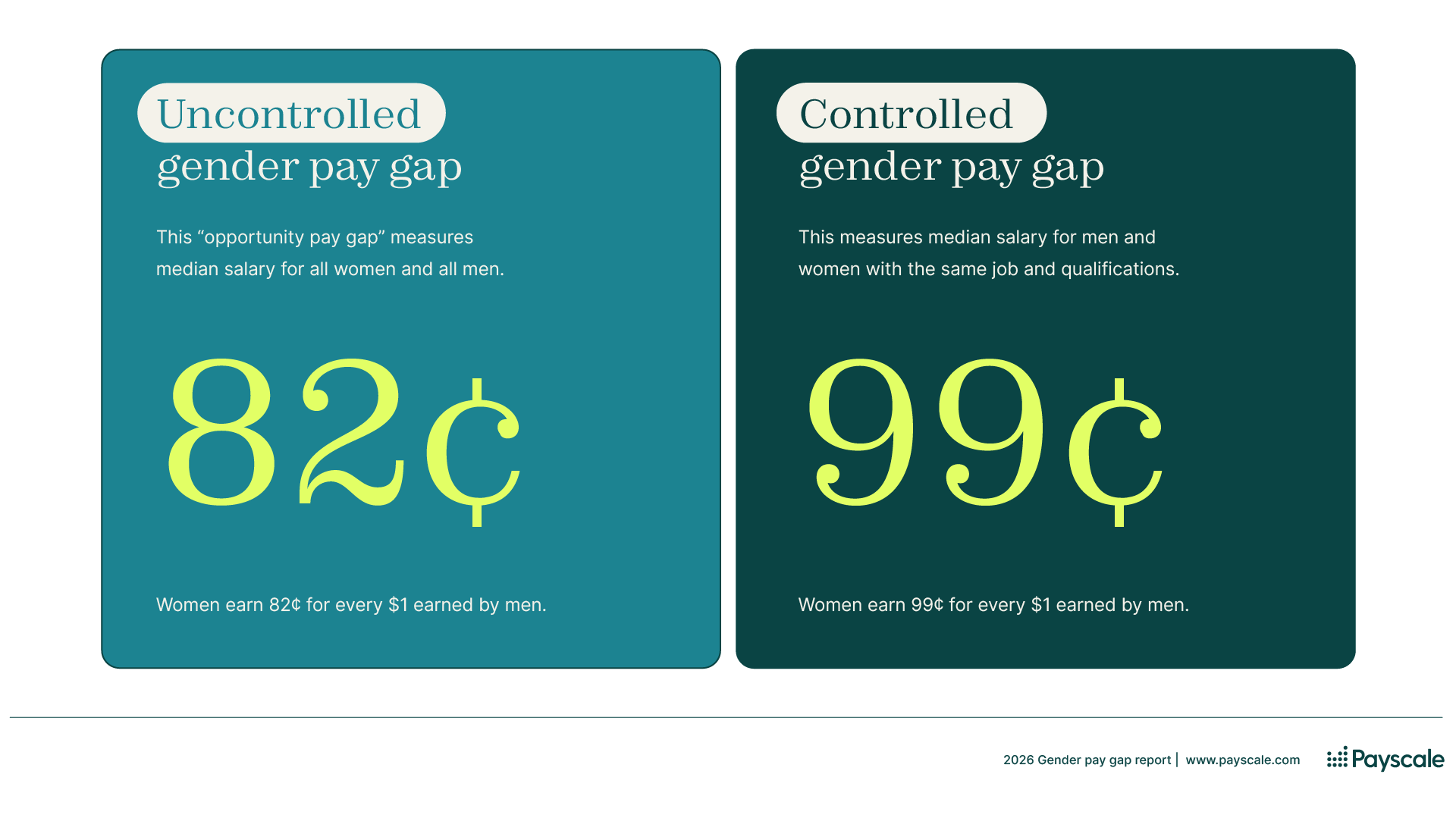
We calculate and present the gender pay gap in two ways: controlled and uncontrolled.
The uncontrolled gender pay gap measures what women earn in the workforce compared to men without accounting for job title. The uncontrolled gender pay gap is sometimes called the “opportunity gap.”
A common way to look at the gender pay gap is as a percentage of how much women make compared to men (as a fraction of a dollar). In 2026, the uncontrolled gender pay gap is $0.82, meaning that women collectively earn 18% less than men based on how they’re paid for the jobs they have now. This gap widened from $0.83 in 2024, when it was 17%.
The controlled gender pay gap measures “equal pay for equal work,” meaning how women are paid compared to men in the same jobs or jobs with similar qualifications.
When data are controlled for job title and other compensable factors, the gender pay gap narrows to $0.99, which is a gap. This means that at least some women receive unequal pay for the same or similar work. This figure is unchanged from last year.
The uncontrolled gender pay gap is not less meaningful than the controlled gender pay gap. The uncontrolled gap reflects the overall difference in earnings between men and women across the economy, including differences in the types of jobs held and career progression. Even if the controlled gender pay gap closes entirely — meaning women and men with the same job title and qualifications are paid equally — a remaining uncontrolled gap would indicate that men and women are not equally represented in higher-paying roles.
Payscale can help employers monitor the controlled and uncontrolled pay gap in their organizations.
The gender pay gap over time
The gender pay gap widened in 2026
The median salary for men is higher than the median salary for women and has been since Payscale started tracking the gender pay gap. The difference between the earnings of women and men has shrunk, but only by a small amount each year.
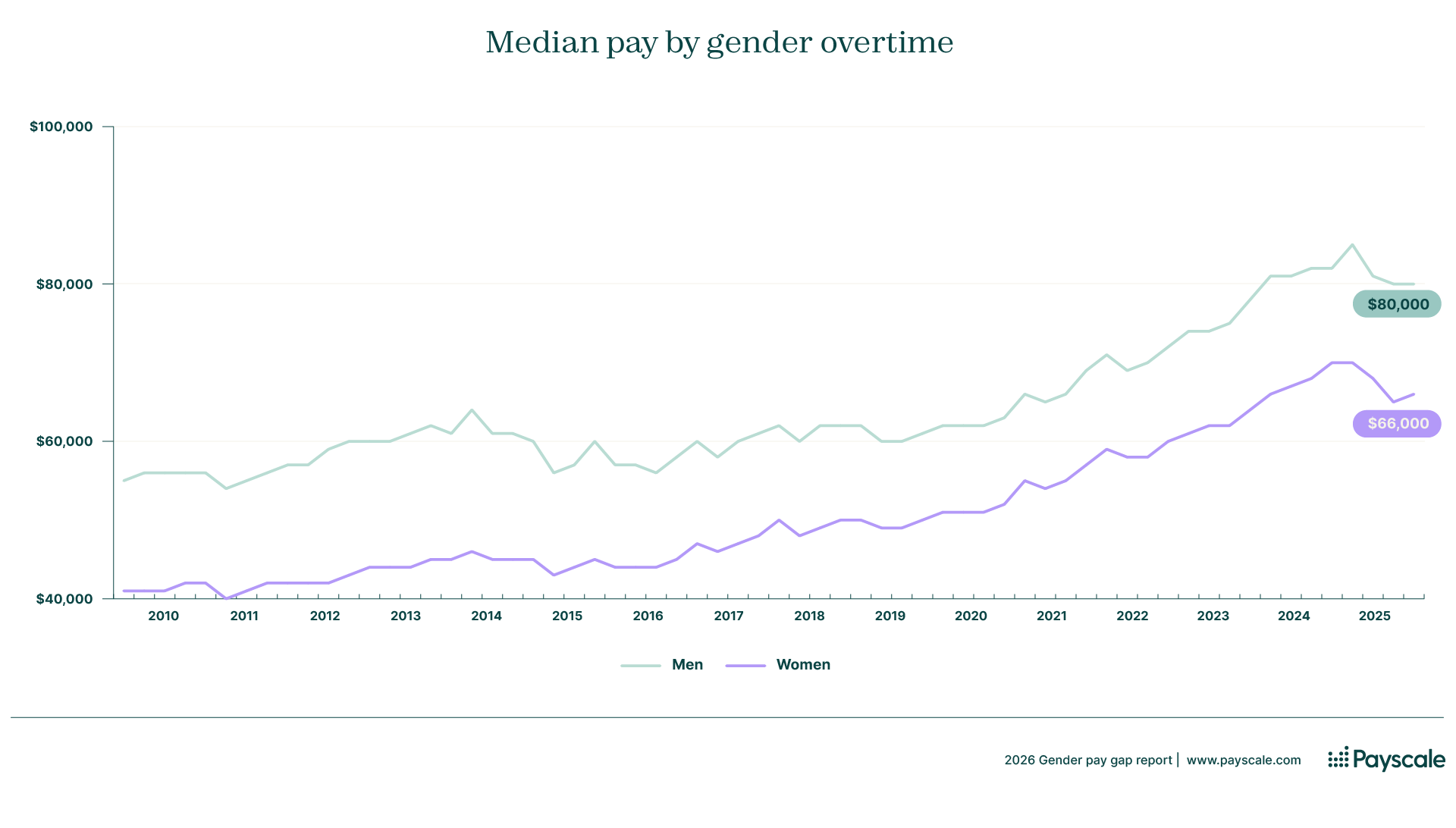
This year, Equal Pay Day falls on March 26, 2026. This date represents how many additional days into the year women must work to earn what men did in the previous year in the United States when data are uncontrolled.
Equal Pay Day moved backward one day in 2026, as it was March 25 in 2025. It was March 12 in 2024, representing a widening of the gender pay gap in recent years despite the expansion of pay transparency legislation, which has been shown to close pay gaps.
In 2026, Payscale’s data shows a widening of the uncontrolled gender pay gap, corroborating research from other organizations. The uncontrolled gender pay gap widened by $0.01, while the controlled gap stayed the same.
The uncontrolled gender pay gap is what women make compared to men regardless of occupation, experience, education, and other compensable factors. Payscale controls for a wide variety of compensable factors, not just job titles.
When data are controlled, there is still a gap, with women making $0.99 for every $1 men earn. This difference has remained unchanged for five years.
The gap between what women and men are paid has persisted year over year despite the passing of the Equal Pay Act in 1963. The uncontrolled gender pay gap tells us that high-earning jobs are occupied more by men than women, while the presence of the controlled gender pay gap tells us that women are still being paid less than men when doing the same jobs at least some of the time.
As our data will show, the uncontrolled pay gap persists across all levels of educational attainment. The gender pay gap also widens as women age and progress in their careers.
The controlled gender pay gap has narrowed over time (and even closed) in recent years for some occupations and industries. The controlled pay gap has also closed in some states, sometimes associated with passage of pay transparency legislation.
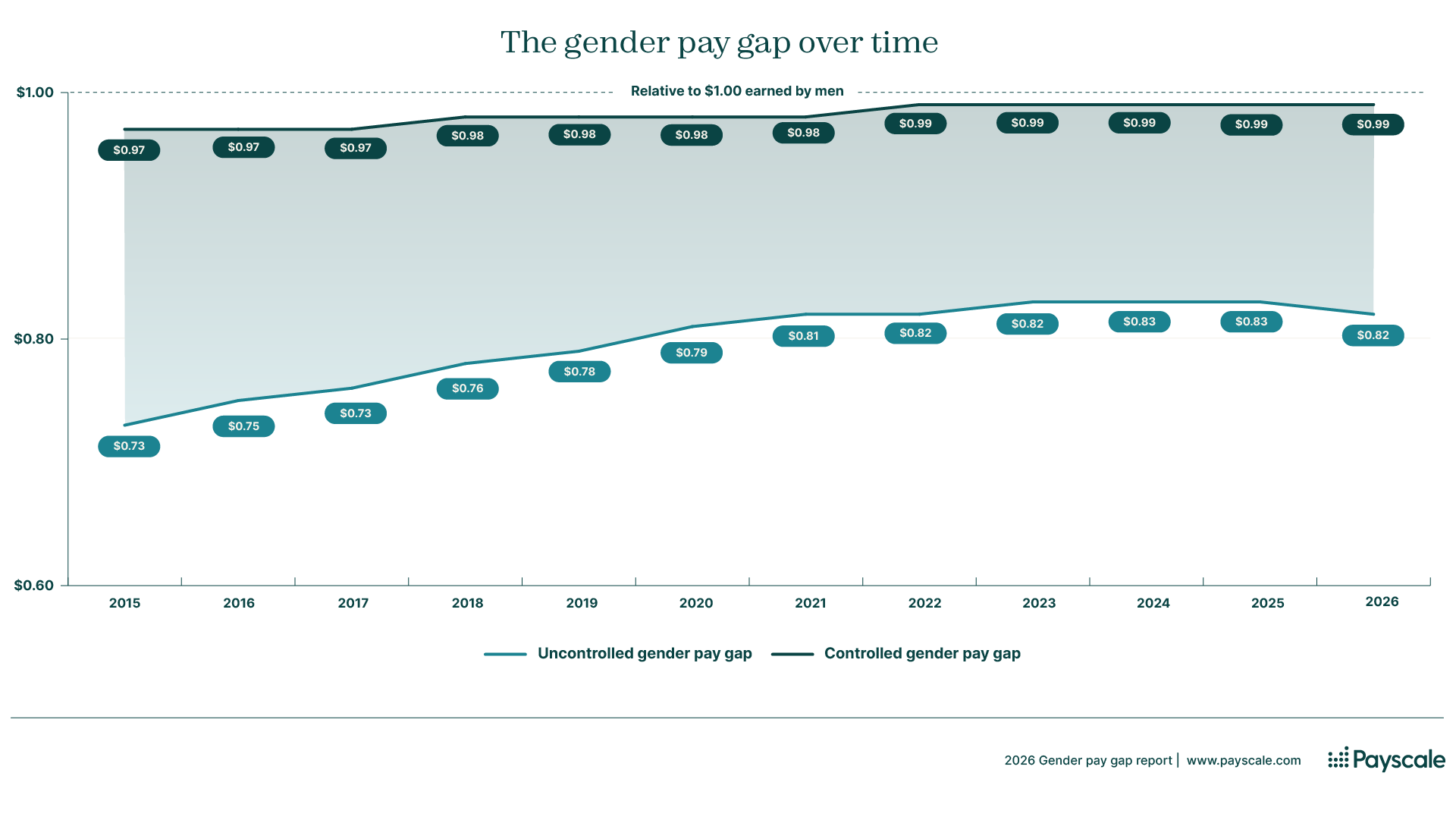
| Year | Uncontrolled Gender Pay Gap | Controlled Gender Pay Gap |
|---|---|---|
2026 | $0.82 | $0.99 |
2025 | $0.83 | $0.99 |
2024 | $0.83 | $0.99 |
2023 | $0.83 | $0.99 |
2022 | $0.82 | $0.99 |
2021 | $0.82 | $0.98 |
2020 | $0.81 | $0.98 |
2019 | $0.79 | $0.98 |
2018 | $0.78 | $0.98 |
2017 | $0.76 | $0.97 |
2016 | $0.75 | $0.97 |
2015 | $0.73 | $0.97 |
Lifetime earnings
In 2026, we estimated the lifetime earnings lost due to the gender pay gap. Lifetime earnings is the sum of median pay from each year over 40 years, where each year the median pay increases by 3 percent. This is because 3 percent has been found in previous research to be a standard annual increase in base pay by the majority of employers.
The uncontrolled gender wage gap amounts to an annual $14,300 difference in the median salary between women and men in 2026. The difference in lifetime earnings brings this number into stark relief: men earn $1 million dollars more compared to women over a 40-year career with standard annual wage growth.
For the roughly 80 million women in the U.S. workforce, lost earnings of 18% due to the gender wage gap amounts to approximately $1.1 trillion in a single year. Over the course of their careers, women collectively earn $86.4 trillion less than men.
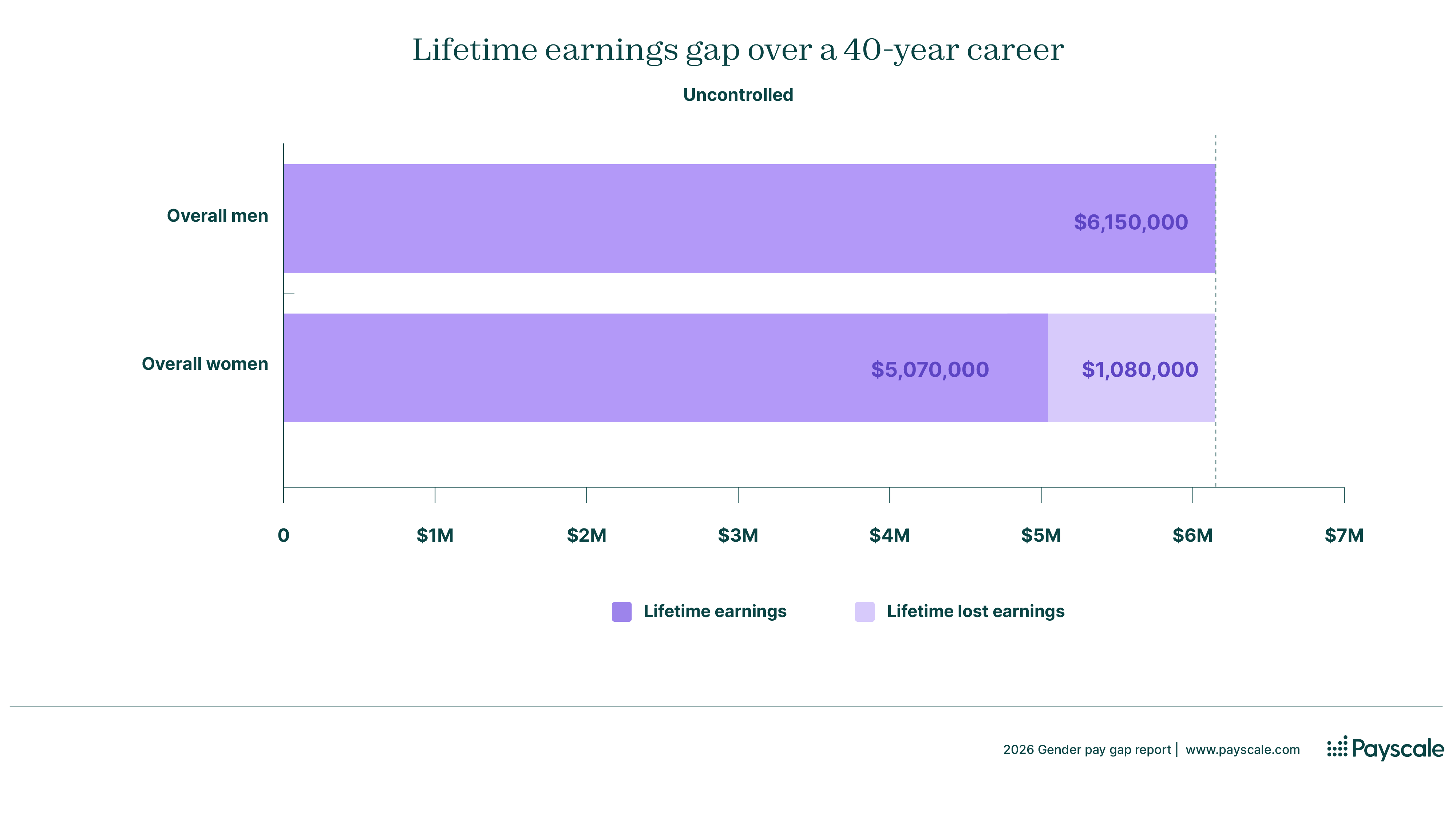
| Sample | Uncontrolled Lifetime Earnings | Uncontrolled Difference in Earnings from all men |
|---|---|---|
Overall Women | $5,070,000 | -$1,080,000 |
Overall Men | $6,150,000 | - |
When analyzing lost lifetime earnings by race, we find that American Indian and Alaskan Native women see the largest estimated lost earnings over a lifetime, totaling $1.7 million. Note that lifetime earnings for women overall includes women who did not provide their race in the survey.

| Race* (women only unless otherwise noted) | Uncontrolled Difference in Earnings from white men | Controlled Difference in Earnings from white men |
|---|---|---|
Overall Women | -$1,510,000 | -$60,000 |
American Indian and Alaska Native | -$1,700,000 | -$170,000 |
Asian | -$280,000 | $40,000 |
Black or African American | -$1,420,000 | -$90,000 |
Hispanic | -$1,390,000 | -$20,000 |
Native Hawaiian and Other Pacific Islander | - | - |
White | -$1,170,000 | -$80,000 |
White men | - | - |
*The samples for racial/ethnic grouping is restricted to those with at least a bachelor's degree. |
Jobs with the widest pay gaps
Where women make less than men in specific jobs
While on average women earn $0.99 compared to $1 for men when data are controlled, the pay gap is wider for some jobs. To show where women are earning less than men for the same or similar work, Payscale looked at the top 20 jobs with the widest controlled gender pay gaps.
The top three positions in the top 20 list included Wholesale and Retail Buyers, which are new this year, as well as Pharmacy Technicians and Claims Adjusters, which were also on the list last year. The rest of the top 20 jobs show a variety of positions across all industries, including Finance, Law, Real Estate, Education, Operations, Retail, and Technology. Seven of the top 20 jobs with the widest gender pay gaps this year also made the list last year.
Note: Brief descriptions of the top 20 jobs with the widest pay gaps from ONET can be found in the methodology.

Why is there a gender pay gap?
The gender pay gap reflects differences in the types of jobs men and women hold, career progression patterns, and the difference in pay for comparable roles. Multiple factors contribute to these outcomes.
Understanding the factors that drive the gender wage gap between men and women (and where gaps are widest) is an important consideration for a compensation strategy built on market data, role requirements, and consistent criteria for hiring and promotion.
Parental status
The pay gap widens for women who are parents.
In our online salary survey, we asked respondents if they are a parent or primary caregiver. We used this data to analyze pay gaps among men and women with and without children.
Women who indicated they are a parent or primary caregiver earn $0.74 for every dollar earned by a man when data are uncontrolled. This is $0.01 wider than last year. When all else is equal, mothers earn $0.99 for every dollar earned by fathers with the same employment characteristics. While the uncontrolled pay gap widened slightly, the controlled pay gap narrowed from $0.98 in 2025.
Conversely, the gender pay gap shrinks for men and women who aren’t parents. The uncontrolled gender pay gap decreased to $0.90 on the dollar (from $0.88 last year), suggesting women without children face fewer social barriers in obtaining high-paying jobs.
This pattern is consistent with research from Columbia University, which found that women earn half as much following childbirth, and their earnings remain depressed for years after, including for women who are the primary breadwinners in their households.
The data show that parental status affects pay outcomes differently for men and women. Women who are parents face wider pay gaps, while the gap narrows for women without children. Research has documented that career progression patterns differ for mothers compared to fathers.

| Are you a parent or primary caregiver? | Uncontrolled gender pay gap | Controlled Gender Pay Gap |
|---|---|---|
Yes | $0.74 | $0.99 |
No | $0.90 | $1.02 |
Race
Women of color face even wider pay gaps
While white women earn $0.82 on the dollar uncontrolled (matching the overall gender pay gap in our sample), American Indian and Alaska Native women earn just $0.74, Black or African women earn $0.78, and Hispanic women earn $0.79 for every dollar earned by white men uncontrolled. Asian women are closest to pay parity with white men, with a $0.96 uncontrolled pay gap.
When data are controlled, Asian and Hispanic women find pay parity with white men while Black or African American women and white women have the same gap ($0.99 on the dollar) as women overall. However, American Indian and Alaska Natives see a wider controlled pay gap at $0.97. Wholistically, American Indian and Alaska Native women see the most pronounced pay gaps in 2026; this group also lost ground from 2025.
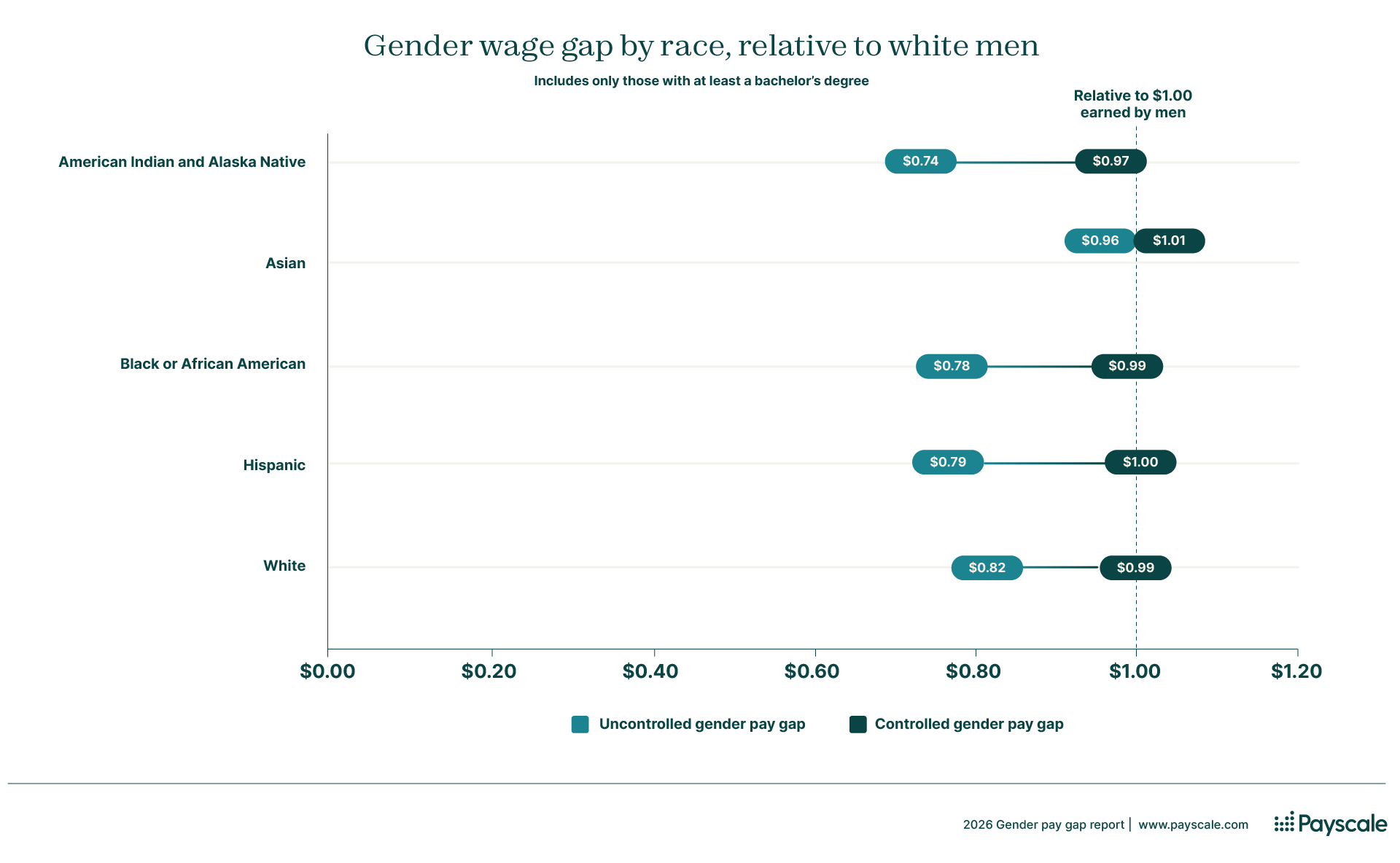
| Race* (women only unless otherwise noted) | Uncontrolled gender pay gap relative to white men | Controlled gender pay gap relative to white men |
|---|---|---|
American Indian and Alaska Native | $0.74 | $0.97 |
Asian | $0.96 | $1.01 |
Black or African American | $0.78 | $0.99 |
Hispanic | $0.79 | $1.00 |
Native Hawaiian and Other Pacific Islander | - | - |
White | $0.82 | $0.99 |
White men | - | - |
*The sample is restricted to those with at least a bachelor's degree. |
Age
The gender pay gap widens as women age
Women begin their careers earning less than men when data are uncontrolled, and the pay gap only widens with age. Between 20 and 29, women earn $0.86 for every dollar men earn. When controlling for job title and other compensable factors, women and men earn equal pay in the 20 – 29 age bracket.
However, the pay gap widens for women between the ages of 30 and 44. Women earn $0.80 for every dollar men earn with data uncontrolled and $0.98 when controlling for job title and compensable factors. The uncontrolled wage gap widened by $0.01 in 2026 compared to 2025, while the controlled gap stayed the same for this pay bracket.
At age 45 and older, the gap widens even further for both the uncontrolled and controlled groups: to $0.71 and $0.97 respectively. Both the uncontrolled and controlled gender pay gaps also widened by $0.01 compared to last year. The uncontrolled wage gap for women 45 and older has widened by several points since 2020.
The most likely reason for the gender wage gap widening with age is women becoming mothers and taking lower-paying jobs, despite men equally being parents.

Education
The gender pay gap is not due to a lack of education
Higher education does not lead to pay equity for women. The uncontrolled gender wage gap sees minimal to no improvement at higher education levels. It widens for those holding either a master's degree or MBA at $0.80 and $0.78 respectively.
Looking at the controlled gender wage gap tells a more nuanced story. The gender pay gap closes for women with an associate’s, bachelor’s, and master’s degree when controlling for job title and other compensable factors. Other degrees only narrow the controlled gap.
In 2026, the widest controlled gap occurs for women with juris doctor degrees. They earn $0.94 for every dollar men earn for the same or similar jobs. This is wider than last year, when it was $0.97.
Academic research from Texas A&M University concludes that sterling academic credentials simply don’t carry the same pay premium for women compared to men.

| Education level | Uncontrolled gender pay gap | Controlled gender pay gap |
|---|---|---|
High school diploma or GED | $0.86 | $0.97 |
Associate's degree | $0.90 | $1.01 |
Bachelor's degree | $0.83 | $1.02 |
Master's degree (non-MBA) | $0.80 | $1.01 |
Master of business administration (MBA) | $0.78 | $0.98 |
Law degree (JD, LLM) | $0.82 | $0.94 |
Health professional doctorate (MD, DMD, DVM, etc.) | $0.91 | $0.98 |
Doctorate (PhD) | $0.84 | $0.97 |
States
Pay transparency is closing the controlled gender wage gap
U.S. pay transparency legislation began requiring the publication of pay ranges in job ads in some states in 2022. It continues to pick up steam. The intention of pay transparency legislation is to close pay gaps, forcing organizations to openly advertise pay ranges and commit to pay equity.
While pay transparency laws increase the likelihood of closing the controlled gender pay gap, it doesn’t happen immediately. Nine out of 15 states (60%) with pay transparency laws closed the controlled gender pay gap in 2026. However, 10 additional states closed the controlled gender pay gap in the absence of a statewide pay transparency law. Overall, 38% of states have closed the controlled gender pay gap in this year’s sample.
Because employers hire across states, pay transparency in one state can affect hiring practices in other states. According to Payscale’s 2026 Compensation Best Practices Report, 42% of organizations post salary ranges for all roles, regardless of location.

| Source: 2026 Compensation Best Practices Report | |
|---|---|
We post salary ranges only in locations required by law | 28% |
We post salary ranges in some locations beyond legal requirements | 9% |
We post salary ranges for all roles, regardless of location | 42% |
Unsure/Still evaluating our approach | 4% |
We do not post salary ranges | 17% |
That 19 states have closed the controlled gender wage gap in 2026 is a recent development. Because it is recent, which states show a closed gender pay gap fluctuates year over year and won’t be officially deemed closed until we see it closed consistently for several years. California, Connecticut, Maryland, New Jersey, New York, Oregon, and Washington, D.C. have remained closed for three years. Delaware has been closed for two years.
States that have closed the gender pay gap in 2026 include:
- California
- Connecticut
- Delaware
- District of Columbia
- Hawaii
- Illinois
- Kansas
- Maryland
- Minnesota
- Montana
- North Carolina
- New York
- Oregon
- Pennsylvania
- South Carolina
- South Dakota
- Vermont
- Wisconsin
- Wyoming
Nine states with pay transparency laws closed the controlled gender pay gap in 2026:
- California ($1.00)
- Connecticut ($1.04)
- District of Columbia ($1.02)
- Hawaii ($1.00)
- Illinois ($1.00)
- Maryland ($1.00)
- Minnesota ($1.01)
- New York ($1.00)
- Vermont ($1.00)
However, six states with pay transparency laws did not close the controlled gender pay gap:
- Colorado ($0.98)
- Massachusetts ($0.98)
- Nevada ($0.95)
- New Jersey ($0.99)
- Rhode Island ($0.94)
- Washington ($0.99)
Additionally, 10 states without pay transparency closed the controlled gender pay gap.
- Delaware ($1.00)
- Kansas ($1.00)
- Montana ($1.07)
- North Carolina ($1.01)
- Oregon ($1.02)
- Pennsylvania ($1.00)
- South Carolina ($1.01)
- South Dakota ($1.00)
- Wisconsin ($1.00)
- Wyoming ($1.02)
Notably, no state has closed the uncontrolled gender wage gap. Nevada and the District of Columbia come the closest with women earning $0.91 for every dollar earned by men.
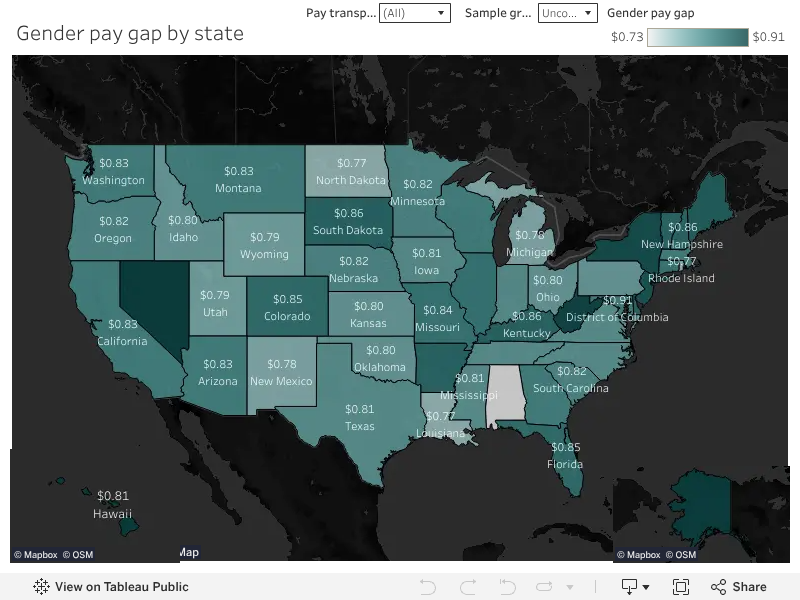
Industry
The controlled gender wage gap closes for some industries
When accounting for job and other compensable factors, the controlled gender pay gap varies significantly across industries.
Where no industries had a closed gender pay gap in years past, four industries now show women earning pay equal to men in comparable roles when data are controlled, including more male-dominated fields such as Engineering & Science and Technology where women represent only 39% and 31% of the workforce respectively.
Real Estate & Rental/Leasing and Arts, Entertainment & Recreation also closed the controlled gender pay gap, despite the overrepresentation of men in these industries.
The industries with the widest controlled gender wage gap include:
- Accommodation & Food Services: $0.95 controlled pay gap (53% women)
- Retail & Customer Service: $0.96 controlled pay gap (51% women)
- Transportation & Warehousing: $0.96 controlled pay gap (25% women)
- Nonprofits: $0.97 controlled pay gap (69% women)
However, female-dominated industries don’t necessarily have better pay equity. Men still make more in industries where women are more represented.
- Health Care: $0.99 controlled pay gap (76% women)
- Education: $0.98 controlled pay gap (69% women)
- Nonprofits: $0.97 controlled pay gap (69% women)

| Industry | Controlled gender pay gap |
|---|---|
Accommodation & Food Services | $0.95 |
Arts, Entertainment & Recreation | $1 |
Real Estate & Rental/Leasing | $1.02 |
Tech | $1.01 |
Construction | $0.99 |
Education | $0.98 |
Health Care | $0.99 |
Energy & Utilities | $0.98 |
Retail & Customer Services | $0.96 |
Engineering & Science | $1 |
Manufacturing | $0.98 |
Nonprofits | $0.97 |
Agencies & Consultancies | $0.98 |
Transportation & Warehousing | $0.96 |
Finance & Insurance | $0.98 |
The uncontrolled gender pay gap hasn’t closed for any industry
The uncontrolled gender wage gap has not closed for any industry in the United States. The uncontrolled gender wage gap reflects where women and men work within industries. In Finance, for example, women may be concentrated in bank teller and customer service roles while men are more likely to be in higher-paid investment banking positions.
Industries with the widest uncontrolled pay gaps in 2026:
- Finance & Insurance ($0.79 uncontrolled pay gap)
- Transportation & Warehousing ($0.83 uncontrolled pay gap)
- Engineering & Science ($0.87 uncontrolled pay gap)
- Manufacturing ($0.87 uncontrolled pay gap)
- Nonprofits ($0.87 uncontrolled pay gap)
- Retail & Customer Service ($0.88 uncontrolled pay gap)
Industries nearest to closing uncontrolled pay gaps in 2026:
- Accommodation & Food Services: Women earn $0.97 on the dollar (53% women)
- Arts, Entertainment & Recreation: Women earn $0.94 on the dollar (47% women)
- Real Estate & Rental/Leasing: Women earn $0.92 on the dollar (47% women)
The uncontrolled pay gap may appear smaller in industries where both men and women are concentrated in low-wage work and/or where unions control pay scales. In Accommodation & Food Services, the narrower uncontrolled gap ($0.97) reflects the reality that many workers (regardless of gender) earn minimum wage.
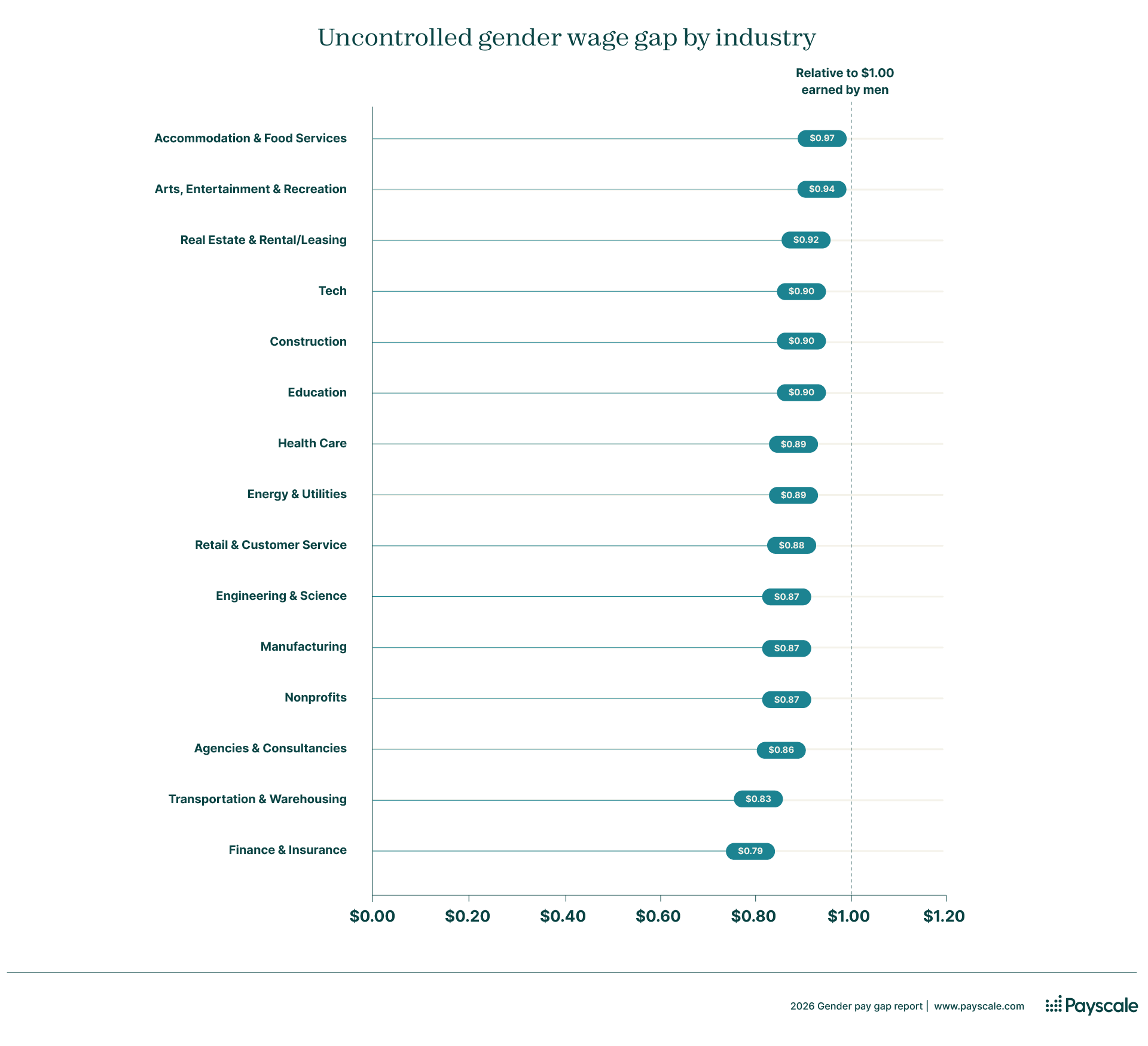
| Industry | Uncontrolled gender pay gap |
|---|---|
Accommodation & Food Services | $0.97 |
Arts, Entertainment & Recreation | $0.94 |
Real Estate & Rental/Leasing | $0.92 |
Tech | $0.90 |
Construction | $0.90 |
Education | $0.90 |
Health Care | $0.89 |
Energy & Utilities | $0.89 |
Retail & Customer Service | $0.88 |
Engineering & Science | $0.87 |
Manufacturing | $0.87 |
Nonprofits | $0.87 |
Agencies & Consultancies | $0.86 |
Transportation & Warehousing | $0.83 |
Finance & Insurance | $0.79 |
Occupations
The controlled gender pay gap closes for some occupations
Note: We report data for 21 occupations as defined by the Standard Occupational Classification System.
When accounting for job titles and other compensable factors, the controlled gender wage gap varies significantly across occupations.
Seven occupations show a closed controlled gender pay gap in 2026:
- Building & Grounds Cleaning & Maintenance: $1.04 controlled pay gap
- Personal Care & Service: $1.03 controlled pay gap
- Construction & Extraction: $1.01 controlled pay gap
- Arts, Design, Entertainment, Sports & Media: $1.00 controlled pay gap
- Life, Physical & Social Science: $1.00 controlled pay gap
- Education, Training & Library: $1.00 controlled pay gap
- Food Preparation & Serving Related: $1.00 controlled pay gap
The occupations with the widest controlled gender wage gaps include:
- Protective Service: $0.89 controlled pay gap (25% women)
- Transportation & Material Moving: $0.91 controlled pay gap (22% women)
- Installation, Maintenance & Repair: $0.92 controlled pay gap (5% women)
- Production: $0.94 controlled pay gap (29% women)
- Sales & Related: $0.95 controlled pay gap (48% women)
Occupations with low female representation — Protective Service (25% women), Transportation & Material Moving (22% women), and Installation, Maintenance & Repair (5% women) — show the widest controlled gender pay gaps. Women in these occupations doing comparable work see larger pay differences than in other fields.
Interestingly, Construction & Extraction has achieved pay equity. This is likely due to standardized union pay scales and high demand for labor. However, Construction & Extraction also notably employs only 4% women.
Occupations with the least women include:
- Construction & Extraction: 4% women ($1.01 controlled pay gap)
- Installation, Maintenance & Repair: 5% women ($0.92 controlled pay gap)
- Architecture & Engineering: 17% women ($0.97 controlled pay gap)
- Transportation & Material Moving: 22% women ($0.91 controlled pay gap)
- Protective Service: 25% women ($0.89 controlled pay gap)
Most of these occupational groups face gender bias related to traditional gender norms. The percentage of women in these occupational groups is influenced by the support or discouragement women receive when considering or entering these fields. The gender pay gap is not closed for any of these occupational groups with the exception of Construction, and is notably wide for Protective Service. In fact, the controlled gender pay gap is wider than the uncontrolled gender pay gap for the Protective Service occupation.

| Occupation | Controlled gender pay gap |
|---|---|
Arts, design, entertainment, sports & media | $1.00 |
Installation, maintenance & repair | $0.92 |
Life, physical & social science | $1.00 |
Healthcare support | $0.99 |
Healthcare practitioners & technical | $0.97 |
Construction & extraction | $1.01 |
Personal care & service | $1.03 |
Office & administrative support | $0.98 |
Computer & mathematical | $0.97 |
Community & social services | $0.97 |
Architecture & engineering | $0.97 |
Production | $0.94 |
Business & financial operations | $0.98 |
Protective service | $0.89 |
Sales & related | $0.95 |
Food preparation & serving related | $1.00 |
Education, training & library | $1.00 |
Transportation & material moving | $0.91 |
Building & grounds cleaning & maintenance | $1.04 |
Management | $0.96 |
Legal | $0.98 |
The uncontrolled gender pay gap hasn’t closed for any occupational groups
The uncontrolled gender wage gap shows where women are most disadvantaged from securing high paying jobs. Occupations with the widest uncontrolled gaps in 2026 include:
- Legal: $0.59 uncontrolled pay gap
- Management: $0.79 uncontrolled pay gap
- Transportation & Material Moving: $0.87 uncontrolled pay gap
- Building & Grounds Cleaning & Maintenance: $0.86 uncontrolled pay gap
- Education, Training & Library: $0.88 uncontrolled pay gap
- Food Preparation & Serving Related: $0.88 uncontrolled pay gap
The widest uncontrolled gaps reveal occupational hierarchies within professions. The Legal occupation has the worst uncontrolled gap at $0.59. This disparity exposes how men and women may follow different career paths in the same field: women may cluster in family law, legal aid, and public interest roles, while men advance in corporate law positions that command significantly higher compensation.
Similarly, in Transportation & Material Moving ($0.87 uncontrolled), women may be less abundant in high-paying positions like commercial pilots, freight managers, and logistics directors.
Occupations with the most women include:
- Healthcare Support: 85% women ($0.95 uncontrolled pay gap)
- Personal Care & Service: 76% women ($0.92 uncontrolled pay gap)
- Healthcare Practitioners & Technical: 76% women ($0.95 uncontrolled pay gap)
- Education, Training & Library: 73% women ($0.88 uncontrolled pay gap)
- Office & Administrative Support: 72% women ($0.92 uncontrolled pay gap)
These occupations are characterized by high female representation. The data show that majority-female occupations do not eliminate the pay gap — women in these roles still earn less than men in comparable positions.

| Occupation | Uncontrolled gender pay gap |
|---|---|
Arts, design, entertainment, sports & media | $0.97 |
Installation, maintenance & repair | $0.96 |
Life, physical & social science | $0.95 |
Healthcare support | $0.95 |
Healthcare practitioners & technical | $0.95 |
Construction & extraction | $0.93 |
Personal care & service | $0.92 |
Office & administrative support | $0.92 |
Computer & mathematical | $0.92 |
Community & social services | $0.92 |
Architecture & engineering | $0.91 |
Production | $0.91 |
Business & financial operations | $0.90 |
Protective service | $0.90 |
Sales & related | $0.89 |
Food preparation & serving related | $0.88 |
Education, training & library | $0.88 |
Transportation & material moving | $0.87 |
Building & grounds cleaning & maintenance | $0.86 |
Management | $0.79 |
Legal | $0.59 |
Remote work status
Women who work from home experience a wider pay gap
In our survey, we asked participants about remote work status. The answers ranged from:
- No, I can’t telecommute
- Yes, I can work from home as needed
- Yes, I can work from home sometimes
- Yes, I work from home all the time
An uncontrolled gender wage gap exists for women regardless of their work-from-home status, and it’s widest for women who work from home “as needed” ($0.76). This suggests a tradeoff between flexibility and earnings.
Women who can’t work from home had the narrowest uncontrolled pay gap ($0.89). This is likely the result of low-paying minimum wage roles and jobs with union/institutionalized pay schedules. These jobs have more equity as a built-in feature of pay set by unions or legislation, but they’re not as likely to offer remote work.
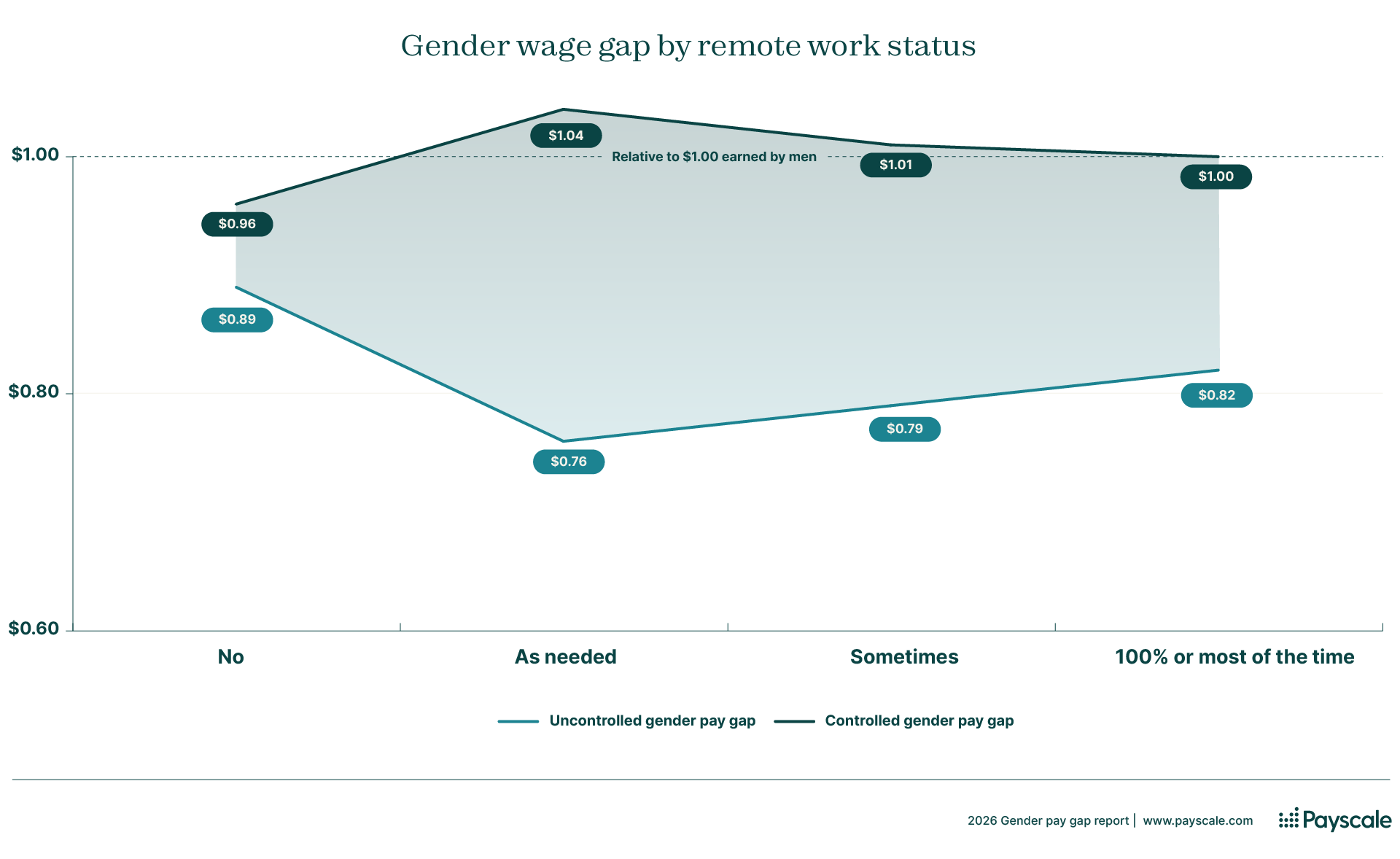
| Remote Work Status | Uncontrolled gender pay gap | Controlled gender pay gap |
|---|---|---|
No | $0.89 | $0.96 |
As needed | $0.76 | $1.04 |
Sometimes | $0.79 | $1.01 |
100% or most of the time | $0.82 | $1.00 |
Job-seeking status
The gender wage gap narrows for women seeking a new job
Both the controlled and uncontrolled pay gap is narrower for women seeking a new job in the next six months. This suggests that those who leave their jobs for new positions may benefit from higher pay offered for in-demand skills and the newest legislative efforts to improve pay equity.
Women seeking new jobs may also be in high-turnover industries where pay is technically more equitable, but less lucrative.
Women who remain at their current job may feel stuck in their positions because of benefits they can’t give up due to parental responsibilities. They may tolerate lower pay for flexible work arrangements.
Women and men often have different career priorities, influencing their decisions to stay or leave an employer. While salary, career growth, and job security are important to both, research shows women are more likely to prioritize workplace culture, flexibility, and work-life balance when deciding to stay with an employer.

| Do you plan to seek a new job in the next 6 months? | Uncontrolled gender pay gap | Controlled gender pay gap |
|---|---|---|
Yes | $0.84 | $1.00 |
No | $0.80 | $0.98 |
Career progression
Women see wider gaps as they climb the corporate ladder
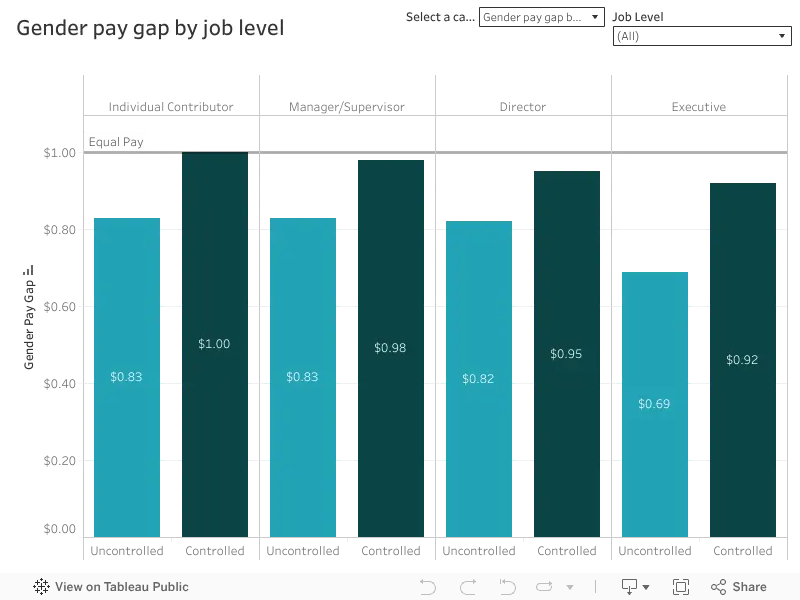
Women who ascend the career ladder make less than their male counterparts at every job level.
As individual contributors, the controlled gender pay gap closes between women and men. Once women reach the level of manager/supervisor, the controlled gender wage gap widens, with women at this level earning $0.98 for every $1 men make. By the time they reach executive level status, the controlled gender pay gap widens for women to $0.92 on the dollar. Last year, it was $0.93.
The uncontrolled gender pay gap persists at all levels and has gotten worse for women in the highest positions with an uncontrolled pay gap of $0.69 for female executives (compared to $0.72 last year).
In addition, when we compare men and women by age at the different job levels, we see that men are promoted faster than women and rise higher, with double the men being executives at age 45 or older (12%) compared to women (6%).
The gender wage gap by job level widens further by race
Data on gender and race by job level reveals that women of color experience wider pay gaps than white women at nearly every level. These gaps persist even after controlling for job title and compensable factors.
At the executive level, the disparities are starkest: the controlled gender pay gap for Hispanic women and Black or African American women is $0.91 relative to white men. The uncontrolled gender pay gap for Black or African American executive women is the lowest at $0.64, followed by Hispanic executive women at $0.67.
The widening of pay gaps at higher job levels suggests that factors beyond job title and qualifications influence pay outcomes at senior levels.

HR’s 2026 guide to pay equity
Pay inequity exists and gender pay gap reporting is now required by the EU Pay Transparency Directive.
Download the 2026 Guide to Pay Equity from Payscale to learn about the pressures driving pay equity and how modern technology for compensation management with pay equity can help you monitor, analyze, and remediate pay gaps.
.png)
Methodology
Between January 2024 and January 2026, over 130K people in the U.S. took Payscale’s online salary survey, providing information about their industry, occupation, location and other compensable factors. They also reported demographic information, including age, gender, and race. We leveraged this sample to provide insights into the controlled and uncontrolled gender pay gap. To ensure a fair comparison, we convert hourly compensation to annual compensation where necessary and re-scale annual compensation to a 40-hour work week where necessary.

We also ask respondents to the survey if they are a parent or able to work from home. We compare the GPG by parent and remote work status. This sample was collected between January 2024 and January 2026 and comprised of 4,439 respondents to the parent question and 2,564 respondents to the remote status question. We also evaluate pay equity among workers who are planning to seek a new job in the next 6 months against those who plan to stay in their job, this sample comprises 85,391 respondents.
Are you a parent or primary caregiver?
- Yes
- No
Are you able to telecommute / work from home?
- Yes, I telecommute 100% of the time
- Yes, I telecommute most of the time
- Yes, I telecommute some of the time
- Yes, I telecommute on an as-needed basis only (e.g., furniture delivery)
- No, I can't telecommute
Do you plan to seek a new job in the next 6 months? Yes/No
ONET Online has detailed descriptions of the world of work for use by job seekers, workforce development and HR professionals, students, developers, researchers, and more. https://www.onetonline.org/.
Wholesale and Retail Buyers, Except Farm Products: Buy merchandise or commodities, other than farm products, for resale to consumers at the wholesale or retail level, including both durable and nondurable goods. Analyze past buying trends, sales records, price, and quality of merchandise to determine value and yield. Select, order, and authorize payment for merchandise according to contractual agreements. May conduct meetings with sales personnel and introduce new products. May negotiate contracts.
Pharmacy Technicians: Prepare medications under the direction of a pharmacist. May measure, mix, count out, label, and record amounts and dosages of medications according to prescription orders.
Claims Adjusters, Examiners, and Investigators: Review settled claims to determine that payments and settlements are made in accordance with company practices and procedures. Confer with legal counsel on claims requiring litigation. May also settle insurance claims.
Sales Managers: Plan, direct, or coordinate the actual distribution or movement of a product or service to the customer. Coordinate sales distribution by establishing sales territories, quotas, and goals and establish training programs for sales representatives. Analyze sales statistics gathered by staff to determine sales potential and inventory requirements and monitor the preferences of customers.
Production, Planning, and Expediting Clerks: Coordinate and expedite the flow of work and materials within or between departments of an establishment according to production schedule. Duties include reviewing and distributing production, work, and shipment schedules; conferring with department supervisors to determine progress of work and completion dates; and compiling reports on progress of work, inventory levels, costs, and production problems.
Property, Real Estate, and Community Association Managers: Plan, direct, or coordinate the selling, buying, leasing, or governance activities of commercial, industrial, or residential real estate properties. Includes managers of homeowner and condominium associations, rented or leased housing units, buildings, or land (including rights-of-way).
First-Line Supervisors: Directly supervise and coordinate activities of workers. May perform some of the same work that subordinates do. Responsible for work assignments, training, performance evaluation, and ensuring work standards are met.
Natural Sciences Managers: Plan, direct, or coordinate activities in such fields as life sciences, physical sciences, mathematics, statistics, and research and development in these fields.
Financial Managers: Plan, direct, or coordinate accounting, investing, banking, insurance, securities, and other financial activities of a branch, office, or department of an establishment.
Lawyers: Represent clients in criminal and civil litigation and other legal proceedings, draw up legal documents, or manage or advise clients on legal transactions. May specialize in a single area or may practice broadly in many areas of law.
Retail Salespersons: Sell merchandise, such as furniture, motor vehicles, appliances, or apparel to consumers.
Financial Analysts: Conduct quantitative analyses of information involving investment programs or financial data of public or private institutions, including valuation of businesses.
Operations Research Analysts: Formulate and apply mathematical modeling and other optimizing methods to develop and interpret information that assists management with decision-making, policy formulation, or other managerial functions. May collect and analyze data and develop decision support software, services, or products. May develop and supply optimal time, cost, or logistics networks for program evaluation, review, or implementation.
Training and Development Specialists: Design or conduct work-related training and development programs to improve individual skills or organizational performance. May analyze organizational training needs or evaluate training effectiveness.
Sales Representatives, Wholesale and Manufacturing, Technical and Scientific Products: Sell goods for wholesalers or manufacturers where technical or scientific knowledge is required in such areas as biology, engineering, chemistry, and electronics, normally obtained from at least 2 years of postsecondary education.
Network and Computer Systems Administrators: Install, configure, and maintain an organization's local area network (LAN), wide area network (WAN), data communications network, operating systems, and physical and virtual servers. Perform system monitoring and verify the integrity and availability of hardware, network, and server resources and systems. Review system and application logs and verify completion of scheduled jobs, including system backups. Analyze network and server resource consumption and control user access. Install and upgrade software and maintain software licenses. May assist in network modeling, analysis, planning, and coordination between network and data communications hardware and software.
Secondary School Teachers, Except Special and Vocational Education: Teach one or more subjects to students at the secondary level (typically grades 9-12 or equivalent).
Industrial Production Managers: Plan, direct, or coordinate the work activities and resources necessary for manufacturing products in accordance with cost, quality, and quantity specifications.
Art Directors: Formulate design concepts and presentation approaches for visual productions and media, such as print, broadcasting, video, and film. Direct workers engaged in artwork or layout design.
Customer Service Representatives: Interact with customers to provide basic or scripted information in response to routine inquiries about products and services. May handle and resolve general complaints. Excludes individuals whose duties are primarily installation, sales, repair, and technical support.
Total Cash Compensation: TCC combines base annual salary or hourly wage, bonuses, profit sharing, tips, commissions, and other forms of cash earnings, as applicable. It does not include equity (stock) compensation, cash value of retirement benefits, or value of other non-cash benefits (e.g., healthcare).
Median Pay: The median pay is the national median (50th Percentile) total cash compensation (TCC). Half the people doing the job earn more than the median, while half earn less.
Uncontrolled Gender Pay Gap: Median pay for men and women are examined separately, and the difference in the median is reported as the uncontrolled gender pay gap. Variables such as years of experience and education are not controlled for. This provides a picture of the differences in wages earned by men and women in an absolute sense.
Controlled Gender Pay Gap: This is the amount that a woman earns for every dollar that a comparable man earns. That is, this is the pay difference that exists between the genders after we control for all measured compensable factors. If the controlled pay gap is $0.97, then a woman would earn 97 cents for every dollar that a man with the same employment characteristics.
Controlled Median Pay: To illustrate the gender pay gap, we calculate this estimate of what the typical woman would earn if she occupied the same position as the typical man.
Industries: Payscale uses 15 industry categories that are custom aggregates of the North American Industry Classification System (NAICS).
Occupations: We report data for 21 occupations as defined by the Standard Occupational Classification System.
Job Levels
- Individual Contributor: Employees who do not manage others.
- Supervisors/Managers: Employees with people management responsibilities.
- Directors: Employees who manage managers, but are below the level of vice president.
- Executives: Employees with the title of vice president or hire.
Percent Men/Women (BLS): We present the gender breakdown by job group or industry according to the Bureau of Labor Statistics Current Population Survey from January 2023. For Industries, we calculated a weighted average of the custom Payscale aggregations of the North American Industry Classification System (NAICS) groups when definitions span multiple NAICS industries (e.g. Technology).
Lifetime earnings is the sum of median pay from each year, over 40 years, where each year the median pay increases by 3 percent. This is because 3 percent has been found in previous research to be a standard annual increase in base pay by the majority of employers.
Uncontrolled: The $0.82 wage gap represents a $14,300 difference in earnings between men and women on average per year - and a difference in lifetime earnings reaching over $1m. For the roughly 80 million women in the U.S. labor force, lost earnings with an 18% wage gap is approximately $1.1 trillion dollars in just one year, or $86.4 trillion over a lifetime career collectively.
Controlled: A one-percentage-point pay gap may appear small, but for an employee in our sample it accounts for a $1,000 difference in earnings in one year. Over a 40-year career, with typical wage growth, that difference compounds into more than $80,000 in lost lifetime earnings—before accounting for retirement contributions or investment growth.
For analysis by race, we look only at those with at least a bachelor’s degree. Racial gender pay gap numbers reported are relative to white men unless otherwise noted. Due to sample size issues, we are unable to report data on Native Hawaiian and other Pacific Islanders beyond the manager level.
Race/Ethnicity: Respondents could choose one or more of the following and could opt to self-identify in an open response.
- American Indian and Alaska Native
- Asian
- Black or African American
- Hispanic
- Native Hawaiian and Other Pacific Islander
- White
- Prefer Not to Answer
Only respondents who chose exactly one of the above were included in our analysis of the gender pay gap by race.
Payscale is the original compensation innovator for organizations who want to scale their business with pay and transform their largest investment into their greatest advantage. With decades of innovation in sourcing reputable data and developing AI-powered tools, Payscale delivers actionable insights that turn pay from a cost to a catalyst. Its suite of solutions — Payfactors, Marketpay, and Paycycle — empower top companies in the U.S. and businesses like Cintas, ZoomInfo, Chipotle, Brookdale Senior Living, Ohio State University, American Airlines, and TJX Companies.
Create confidence in your compensation. Payscale.
To learn more, visit www.payscale.com.