



The job title “AI engineer” has lost all meaning. What used to function as a clear descriptor for an emerging role has fractured into multiple positions, each requiring different skill sets that solve different business problems and command different market ratels.
In 2026, a hiring manager posting for an "AI engineer" might be looking to build ML models, integrate APIs, manage model operations, or automate workflows. To add complication, candidates will often use AI to tailor their resumes to fit into whichever category helps them get considered, regardless of actual experience.
The result is mismatched hires, wasted recruiting cycles, and compensation decisions anchored to the wrong benchmark. The gap between what candidates claim and what they can actually do is widening faster than hiring teams can close it.
The reason behind CV inflation
Data from Lightcast shared recently in Payscale’s Flight Risk Report shows that job descriptions requiring AI skills have skyrocketed in recent years.
.avif)
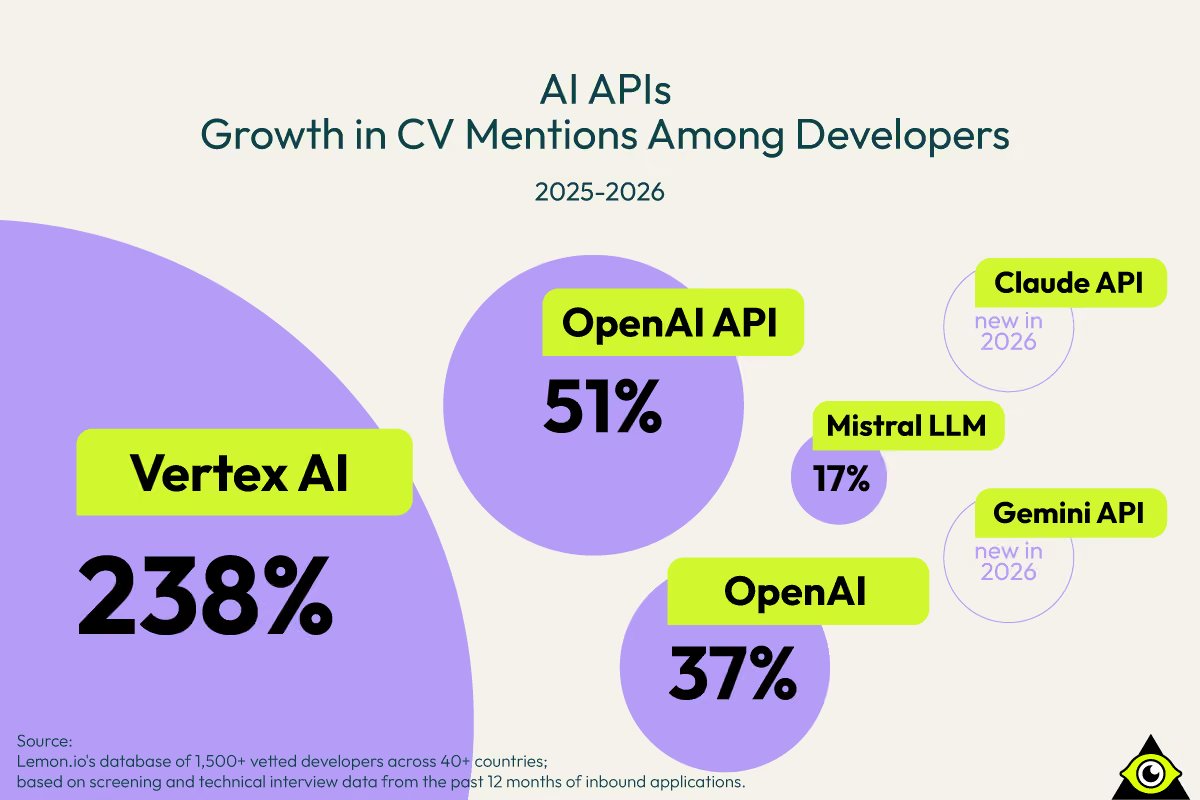
Correspondingly, the volume of candidates listing AI skills in their resumes has exploded. According to Lemon.io's tech talent marketplace data from the Software Developer Rate Benchmark Report (January 2024–April 2026), Vertex AI mentions are up 238% year-over-year, OpenAI API usage is up 51%, and new tools like Claude API and Gemini API appeared in significant numbers for the first time in 2026.
The challenge is that most candidates claiming "AI engineer" experience are describing one of several narrow specializations.
A developer with strong LLM API integration experience — connecting OpenAI, Anthropic, or Gemini APIs into product workflows — genuinely has valuable AI expertise. But they are not interchangeable with an engineer who builds and trains custom ML models. Both are real roles. Both are critical. They are not the same hire.
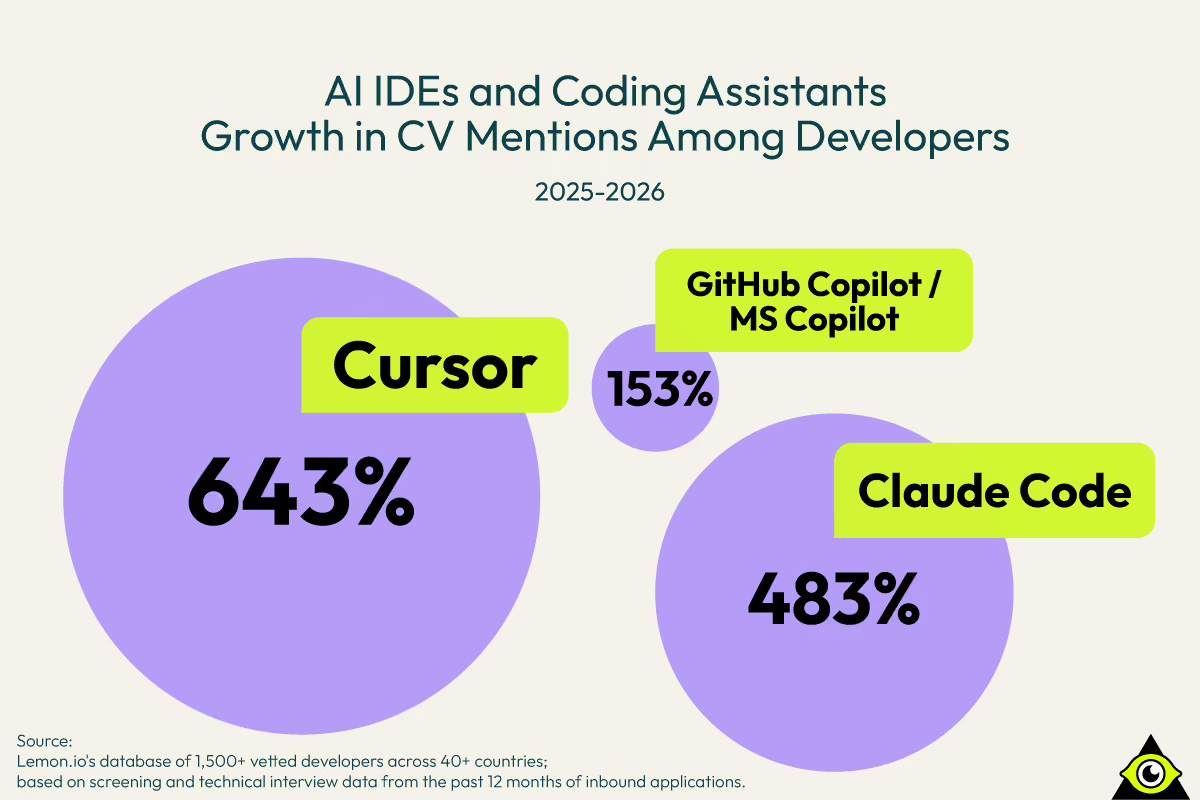
The problem gets worse when you add the explosion of AI coding tools. GitHub Copilot, Claude Code, and Cursor have driven a spike in "AI-assisted development" claims. These tools do increase developer productivity. But proficiency with them is different from specialization in AI engineering. When candidates list "AI engineer" on their resume without clarifying their actual skills, hiring managers anchor to the wrong expectations — and the wrong compensation.
The four types of AI engineering: What you're actually hiring
The confusion starts with imprecise role definition. According to Lemon.io, the "AI engineer" label encompasses four distinct profiles, each with its own technical requirements and market value. Understanding these roles is essential for both contractors and full-time employees, as each commands different compensation and requires different evaluation criteria.
Software Engineer, AI API Integration
This role builds product features using pre-trained AI models and APIs. Specializes in connecting LLM APIs, managing RAG pipelines, and implementing prompt engineering solutions. Real impact: faster time-to-market for AI features without building models from scratch.
Skills: OpenAI API, Claude API, Vertex AI, LangChain, RAG architectures
Software Engineer, LLMOps Development
This role manages the operational layer of deployed AI systems — inference optimization, cost management, monitoring, and scaling. Ensures that production AI systems remain viable as usage grows. Often comes from a platform engineering or DevOps background.
Skills: LangGraph (8,650% YoY growth according to Lemon.io), LangChain orchestration, monitoring tools, deployment platforms
Software Engineer, Machine Learning
This role designs, trains, and manages custom ML models. Works with neural networks, model architectures, and data pipelines. Typically holds formal training in computer science, mathematics, or statistics. This is the role that requires ML frameworks and statistical depth.
Skills: MLflow (280% growth), Hugging Face (121%), Scikit-learn, TensorFlow, PyTorch, model training workflows, specialization in computer vision or NLP
Software Developer, AI-assisted coding
It is now relatively standard for traditional software developers to be expected to use AI tools when coding (Copilot, Claude Code, Cursor) in order to accelerate standard development workflows. This is not an “AI engineer” but it is a significant productivity multiplier for product engineering.
Skills: GitHub Copilot (153% growth), Claude Code (483% growth), Cursor (643% growth), prompt engineering for productivity acceleration
Real AI fluency vs. keywords
The volume of candidates claiming AI skills has grown much faster than the pool who can demonstrate it under evaluation. Skill mentions may get candidates in the door, but the use of keywords in CVs is not a credential.
When evaluating any AI engineering role, look for evidence of practical production experience. Candidates should be able to describe a real system they’ve built, debugged, and shipped. They should understand tradeoffs — why they chose one tool or approach over another. They should know costs and latency constraints specific to their work. And they should be able to articulate what their work accomplished at the product or business level.
A growing mention count on a resume does not demonstrate competency. The difference between verified AI fluency and keyword fluency is the ability to reason about specific problems, make deliberate technical choices, and explain business impact.
What AI-proficient engineers earn as augmented IT experts
Engineers with demonstrated experience combining software development with statistical modeling and cloud infrastructure in an enterprise environment remain scarce. That scarcity earns a premium.
Some organizations hire software engineering on contract while others hire full-time salaried employees. Both are viable sourcing strategies, but they require different compensation approaches and benchmarking methods.
Contractors are independent, hourly-based contributors sourced from staffing agencies, vetted developer marketplaces, job boards, or freelance platforms worldwide. Unlike full-time employees, contractors typically set their own rates or negotiate rates with the agencies that place them.
It's important to understand that contractor rates and salaries work differently. A contractor's hourly rate reflects the amount they charge per hour. But if the contractor is sourced through an agency or marketplace, there's a difference between the bill rate (what the employer pays) and the pay rate (what the contractor receives). Sometimes contractors earn more than comparable full-time employees in the same role. Sometimes they earn less.
According to Lemon.io's Software Developer Rate Benchmark Report (based on 2,500+ verified engagements across 71 countries), a generalist senior back-end developer averages $42.80 per hour globally while a “senior AI engineer” averages $60.30 per hour and can reach $79.20 per hour — an 84% rate premium over mid-level, the steepest seniority progression of any other category in the Software Developer Rate Benchmark Report.
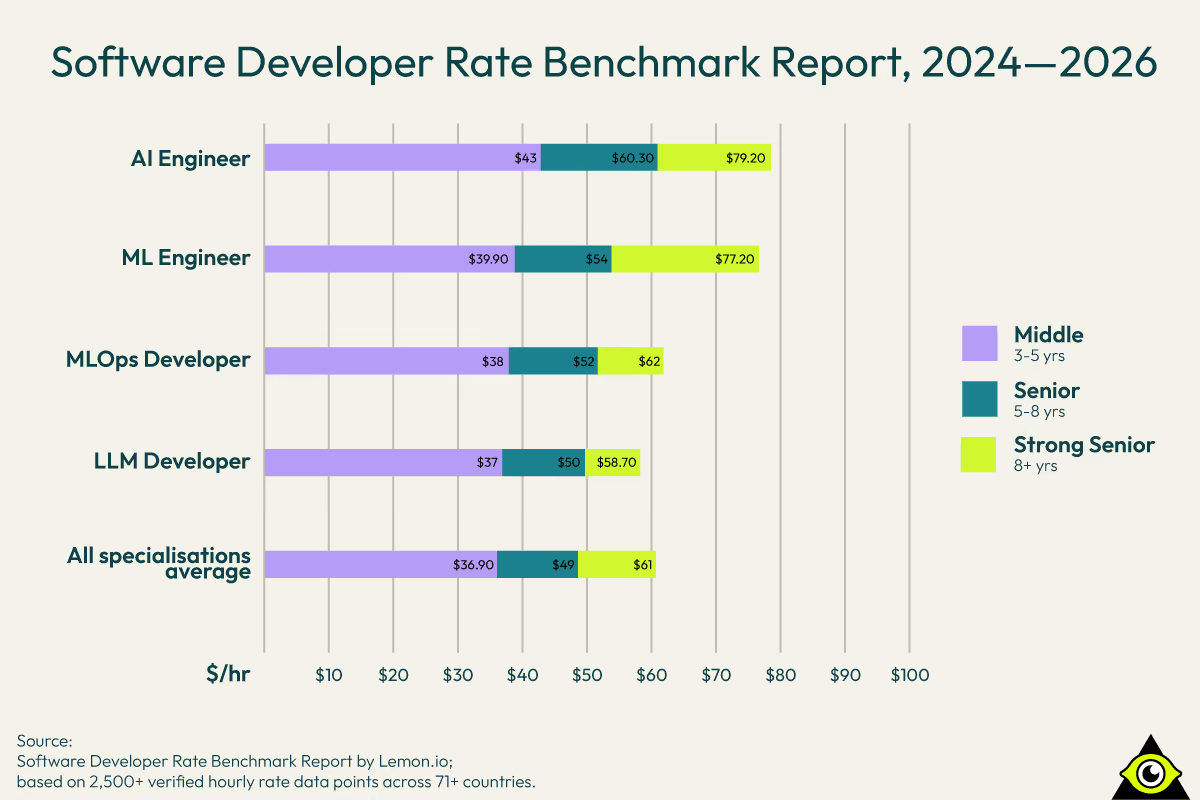
According to Lemon.io, for the other AI-specialized engineering freelancers:
- Machine learning engineers average $54 per hour at the senior level and $77.20 per hour for strong seniors — a 43% step-up between those two tiers, the largest seniority jump among all AI roles.
- MLOps developers earn an average of $52 per hour at the senior level, reflecting the growing complexity of moving models from research to production environments.
- LLM developers — specialists in RAG pipelines, prompt engineering, and AI API integration — average $50 per hour at the senior level, making them the most budget-accessible AI hire with meaningful production impact.
Note that these are global contractor rates.
Salary benchmarking for full-time software engineers
Payscale's compensation management software allows HR and compensation to price jobs for full-time software development roles that account for real job title, job level, skills, geographic differentials, industry, and company size — based on real salary data from similar organizations hiring similar roles in similar locations.
According to Payscale's Flight Risk Report, for example, a Software Engineer V (very senior) commands $230,000 per year (about $110 per hour) as a new hire and $194,000 per year (about $93.27 per hour) as a tenured employee.
The gap between new hires and tenured employees exists because (1) new hires come in at competitive market rates to attract talent and (2) internal pay progression sometimes lags market rate, especially for high-demand skills like AI that are moving faster than salary bands are being adjusted. This salary gap highlights why skills-based compensation and regular market benchmarking are critical.
Making evaluation and compensation decisions systematic
When you have clear role definitions and you're using accurate, skills-based compensation benchmarks, the hiring process becomes more systematic and defensible.
First, define the role accurately when writing the job description. Specify which AI specialization you actually need. Benchmark the job to specific skills, like "Senior Software Engineer—LLM Integration" or "Senior Software Engineer—ML Training," not a vague job title like "AI engineer.”
Second, evaluate candidates through live demonstration and production depth. Don't rely on CV keywords or portfolio projects when assessing job candidates. Your interview process should include asking candidates to solve a problem in real time. This reveals whether they understand tradeoffs, can reason about constraints, and can communicate clearly.
Third, expect business context from senior candidates. Engineers who can explain how their AI work moved the needle are the ones justifying top-of-band compensation. Make that bar explicit in both your job description and evaluation rubric, especially if you are paying a premium for competitive differentiation.
The cost of mispricing is high. Misdefine the role and you'll hire the wrong person for the job, wasting recruiting cycles and onboarding time. Treat "AI engineer" as a single job and you risk either overpaying for generalists or lose specialists to competitors who recognize their true market value.
Need to price a job for full-time software engineers with AI skills?
Learn how Payscale's compensation benchmarking solution with skills-based pay differentials helps compensation and talent acquisition teams work together to create job descriptions that accurately define and price jobs. Our survey-grade, HRIS-sourced salary data is continuously refreshed to capture market changes.
Schedule a conversation with Payscale.
Need to quickly source software engineering talent?
If you’re a hiring manager seeking remote engineers with specific expertise in AI from Europe, LatAm, the US, or Canada, leave your request on Lemon.io.