



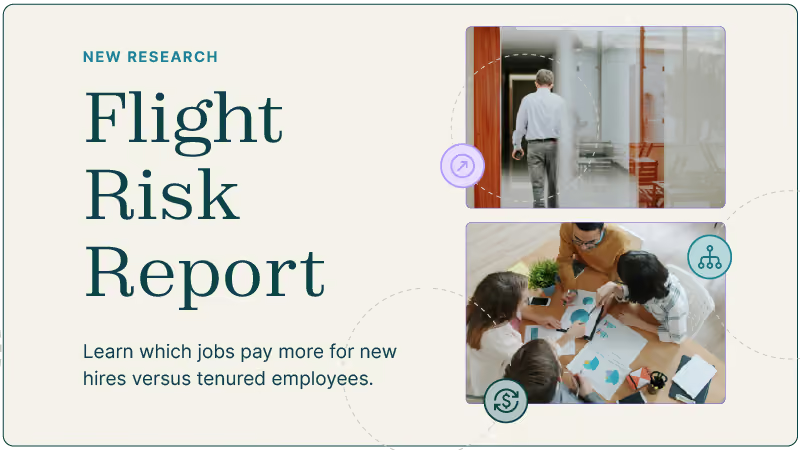
New data from Payscale's 2026 Flight Risk Report reveals something surprising: the roles with the highest attrition risk in 2026 aren't the ones you'd expect — and it challenges what we thought AI would do to the job market.
When we looked at which jobs are paying new hires more than tenured employees — a clear signal of flight risk — we discovered a pattern that challenges everything we’ve been told about AI replacing jobs.
AI is not eliminating roles. It's reshaping what skills are needed and driving higher pay premiums.
What is a flight risk in the context of employment?
Flight risk reflects the likelihood that an employee will leave their current job when external market compensation for similar work exceeds what they're currently paid. In other words, it's the point at which staying becomes financially irrational compared to the opportunities available in the job market.
Let's observe the obvious. In 2026, most employees are not flight risks. They’re staying put. Amidst headlines of what feels like continuous layoffs, the labor market has shifted from "job switching" to "job hugging.” New hires on average earn 3.6% more in market-advantaged roles, while tenured employees in tenure-advantaged roles earn 6.1% more. That's a win for retention overall.
But here's where it gets interesting. When we drill down to specific jobs, we see a concentrated story emerging: there are white-collar, knowledge-based roles commanding premiums that internal pay structures can't keep pace with — and quite a few of them are exactly the same jobs we were told AI would replace.
The top jobs that are flight risks in 2026
The jobs with the highest new-hire market advantage include:
- Marketing Analyst III leading the list with a 12% premium for new hires
- IT Product Manager IV follows at 11%
- Compliance Specialist Sr., Project Management Manager, and Production Manager round out the top five
These roles all require strategic judgment, critical thinking, and the ability to navigate rapid change that has become more valuable in the age of AI.
But there were even bigger surprises. We also looked at the top job for a new hire market advantage for each industry. In the technology industry, Executive Assistants are commanding a 26% premium for new hires. Customer Service Representatives across multiple sectors show similar patterns. These are roles we were told AI would eliminate. Instead, organizations are paying more to hire them.
Why? Because what we're seeing contradicts the prevailing narrative. AI isn't replacing these roles. It's changing what they demand — and what they're worth.
The real story: AI isn't replacing jobs, but it does require reskilling
When we analyzed jobs with tenure advantages — the ones where staying pays more — we saw what we expected: healthcare roles requiring deep institutional knowledge dominate. These are jobs where experience compounds in value.
But in knowledge work, it’s different. Skills evolve faster than compensation systems. In the age of AI, employees are increasingly expected to use AI tools, expand technical capabilities, and master new workflows. Yet job descriptions and pay structures in most organizations haven’t caught up.
The disconnect between rising skill expectations and slower pay progression is a hidden driver of attrition. High performers acquiring new skills aren't seeing their increased market value reflected in their paychecks. They are only rewarded by changing jobs.
HR’s new competitive advantage
Here's the insight that should matter most to HR leaders:
AI adoption is fast becoming a strategic HR responsibility, not an IT initiative.
In the Human Resources job family, we're seeing flight risk concentrated in roles like Training Coordinators and Learning & Development Specialists. These positions — widely assumed to be threatened by AI — are now earning pay premiums.
Why? Because every organization needs people to train their workforce on AI.
This challenges conventional wisdom about AI's impact on HR. Instead of losing headcount to automation, HR is becoming the linchpin of organizational AI transformation. The organizations that recognize this early are likely to have a competitive advantage. Those that don't risk paying high premiums to recruit talent they won’t be able to retain.
What HR teams should do right now
The Flight Risk Report points to actions for HR leaders and compensation professionals:
Treat training and reskilling as strategic, not as a cost center. Organizations need to invest in instructional design and build internal capability that prevents hiring externally at higher premiums.
Update job descriptions to reflect new skill requirements. The Marketing Analyst you need on your team in 2026 isn't the same as one in 2024. Redefine your critical roles around capabilities, modern skills and tools, and the human judgment needed for success — especially where AI is making an impact.
Re-benchmark and reprice every role touched by AI. Don't wait for annual compensation cycles. Marketing, product management, compliance, project management, software development — any role where AI is reshaping responsibilities needs market analysis to ensure appropriate pricing for current market conditions.
Manage pay competitively all year. Low turnover doesn't mean pay doesn’t need to be competitive. When employees stay out of caution rather than satisfaction, disengagement accumulates. You need to monitor external market gaps alongside attrition and engagement metrics.
Link pay to skill growth. Employees adopting AI tools and expanding capabilities should see corresponding rewards. This doesn't require massive increases, but it does require recognition and targeted adjustments that signal the organization values retaining talent.
The bottom line: compensation is central in the age of AI
The 2026 Flight Risk Report reveals how compensation plays a central role in whether employees stay or leave, but it is only a sample of the deeper work that HR, talent acquisition, and compensation teams should be doing.
In a world where AI is changing work faster than annual pay cycles, and where pay transparency gives employees visibility into market rates, compensation strategy cannot lag market reality.
The organizations that get ahead will be those that stop thinking of compensation as a retention lever in ad-hoc situations and start treating it as a competitive strategy with continuous reporting on risk and opportunity. These pay pioneers will benchmark frequently, distribute pay increases strategically, and communicate proactively about how roles are evolving and what new skills are worth.
For HR teams ready to lead that charge, compensation technology has evolved to meet the moment. The Payscale Intelligence Cloud transforms compensation from a once-annual exercise into a continuous function, connecting external market data and internal pay information into insights to inform strategic decision-making. Instead of discovering retention risks after high performers resign, you can identify emerging pay gaps and make strategic adjustments before attrition begins.
The question isn't whether you can afford to benchmark and adjust compensation frequently. It's whether you can afford not to.
Download the full 2026 Flight Risk Report to see the complete analysis of market-advantaged and tenure-advantaged roles.