




Executive summary
AI is pulling the workforce toward a vortex. Where we find ourselves now is chaotic but navigable. However, an event horizon approaches — a point beyond which recovery becomes doubtful for organizations unprepared for the talent crisis ahead.
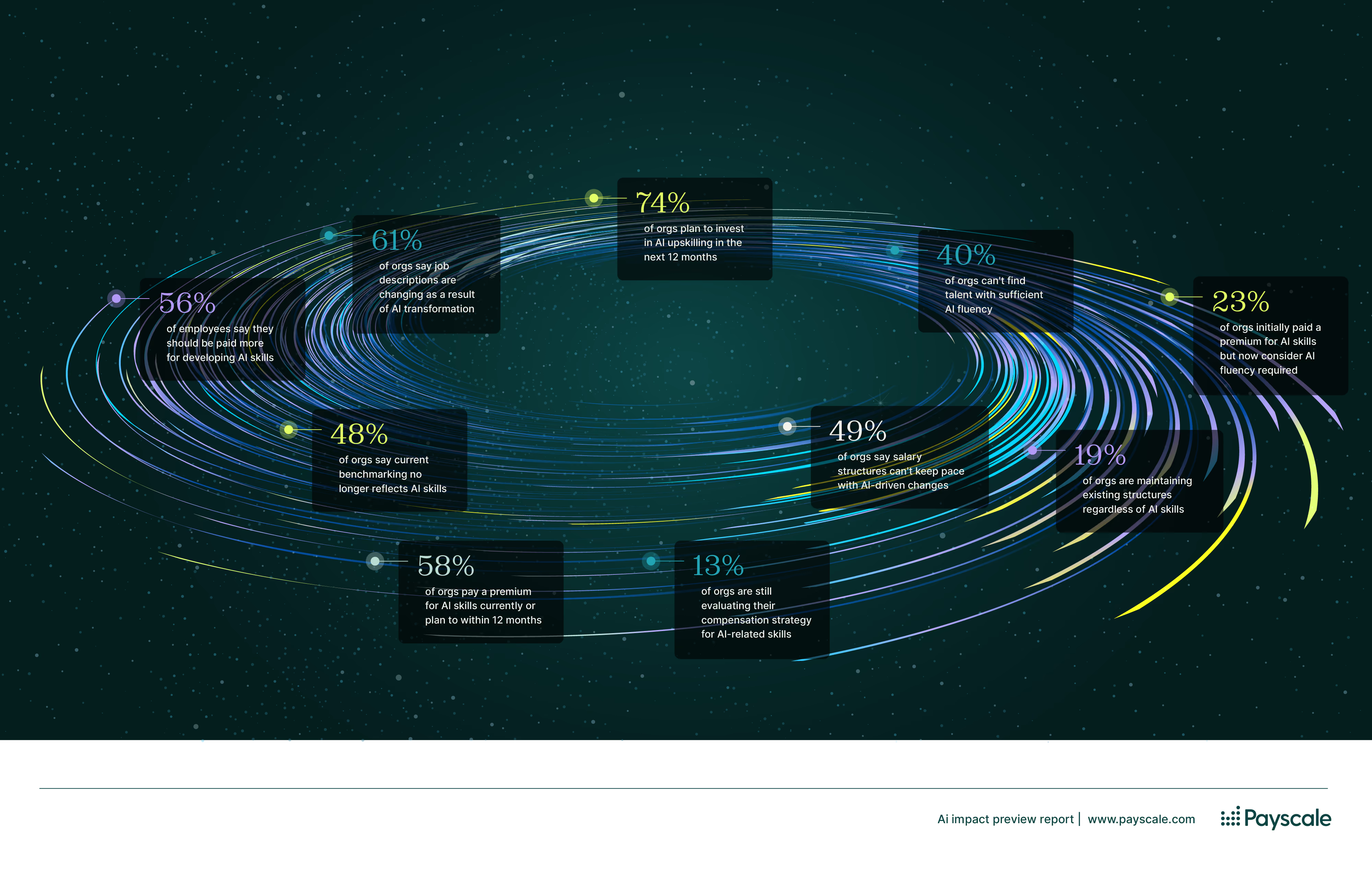
AI skills are transforming jobs. Job postings in the AI sector grew 8.7x over a five year period. Most employers (61%) are already rewriting job descriptions because of AI transformation. Yet only 48% say their market benchmarking reflects the AI skills required. Half (49%) acknowledge their salary structures haven't kept pace.
A talent crisis looms. Many employers (40%) already can't find candidates with sufficient AI fluency. Three-quarters (74%) plan to invest in upskilling to fill the gap. But 56% of employees believe they should be paid more for developing AI skills.
There's a compensation dislocation problem. Employers recognize AI skills deserve rewards. But without market data to guide them, they're creating wage scatter through contradictory approaches: some paying premiums (58%), some treating AI as baseline (23%), some freezing structures (19%), and some still evaluating (13%).
Key findings
- 8.7x job growth paired with above average wage growth in AI roles since 2022
- 74% of employers plan to invest in AI upskilling in the next 12 months
- 61% of employers are rewriting job descriptions due to AI transformation
- 49% of employers say salary structures can't keep pace with AI-driven changes
- 48% of employers say current benchmarking no longer reflects AI skills
- 40% of employers can't find talent with sufficient AI fluency
- 58% of employers are paying premiums for AI skills but are creating wage scatter with inconsistent approaches to rewarding talent
- 56% of employees say they should be paid more for developing AI skills
- 23% of employers initially paid a premium for AI skills but now consider AI fluency required
- 19% of employers are maintaining existing structures regardless of AI skills
- 13% of employers are still evaluating their compensation strategy for AI-related skills
AI’s impact on the labor market
We looked at Lightcast job postings data — within the Lightcast Artificial Intelligence Sector — to assess labor market demand for AI-related jobs in the United States. The top five occupational groups for jobs requiring AI skills are:
- Data Analysis and Mathematics
- Software Development
- Network and Systems Engineering
- Marketing Managers
- Database Specialists
Overall, we see that AI job posts have surged overtime and skyrocketed in recent months, the volume growing 8.7x since 2022. However, AI's impact varies dramatically by industry.
The industries with the highest volume of AI jobs are Professional, Scientific, & Technical Services, Manufacturing, Information, Finance and Insurance, Admin and Support, and Retail. Other industries have seen comparatively low AI job postings, but the Management and Construction sectors grew the fastest.
For the same period (2022 to 2026), the Information, Manufacturing, and Management sectors lead with the highest median wages in AI job postings while Real Estate saw the most dramatic job postings wage growth (+158%).
What the surge in AI means for compensation strategy

So far, AI appears to be more of a job augmenter. AI skill requirements have spread beyond tech roles like AI Applied Engineer. We’re seeing job postings requiring AI skills for roles like Marketing Managers, Operations Managers, and Business Analysts. According to our survey, 61% of employers are rewriting job descriptions due to AI transformation, 40% are struggling to find talent with sufficient AI fluency, and 74% are investing in upskilling.
AI jobs are typically understood to be roles where AI is the primary function (software developers, data analysts), but according to Lightcast data, that's only 1-2% of positions. AI skills — the ability to work effectively with AI tools, evaluate outputs, and adapt as they change — are now starting to be embedded across roles in other occupations such as finance, marketing, HR, operations, and customer service. The same job title can command dramatically different compensation depending on the job description and AI requirements.
The wage strategy varies by organization. Right now, approaches are scattered, but 58% of organizations are rewarding AI skills with pay premiums either now or in the next 12 months. However, 23% have already moved from "premium" to "required baseline." Additionally, a fifth of organizations (19%) haven't changed compensation for AI skills at all.
Traditional surveys lag the market. You need frequently refreshed market data that isolates skills differentials at the time of hire. Almost half (48%) of organizations say their current benchmarking no longer reflects the skills required in AI-transformed roles. Access to demand data with skills differentials is your competitive advantage.
A majority (56%) of employees say that they should receive higher pay for developing AI skills. Your internal talent learning on the job may watch external hires command significant premiums and be tempted to interview to get a pay bump. Without a pay strategy to reward upskilling, you are at risk of attrition.
Technology roles still command the highest wages for AI skills and tech jobs are needed in industries outside of the tech sector, but AI skills are expanding beyond technology. Prioritize jobs where AI is transforming the day-to-day work and where you compete hardest to hire.
It depends on the specific job and skills. For example, for a Business Process Analyst II, Agentic AI and Machine Learning might be competitive skills worth 9% higher median pay whereas those skills may be standard for a Machine Learning Engineer resulting in 0% higher median pay.
Pricing AI roles accurately requires three data inputs working together, not sequentially: 1) current market data refreshed continuously throughout the year; 2) skills differentials that separate which AI capabilities still command a premium from which have become table stakes; and 3) hiring demand data that shows where competition for AI talent is accelerating fastest.
This is exactly what Payscale Ascent, powered by Peer data, aims to deliver. Ascent integrates your salary structures with daily-refreshed market data and isolates skills differentials so you can price AI jobs. Peer aggregates compensation data across thousands of organizations, straight from HR-reported employee salary data in HRIS, so your benchmarks reflect today's market, not last year's cycle.
If you don't make an investment in talent now, you risk spending more backfilling or upskilling later. Run a pay compression report to flag who's below market before they start interviewing. Waiting until they have an offer in hand is typically more expensive than being proactive.
Frame it as retention risk with a dollar figure. Over half (56%) of employees expect higher pay for new skills. Without a strategy, your top performers may walk out the door. Turnover costs 1.5-2x salary. The premium is probably cheaper than fully replacing talent you've trained to understand your organization and who have taken it upon themselves to build AI skills.
Traditional surveys refresh annually. Almost half (48%) of organizations admit their benchmarks don't reflect current AI skill requirements. You need data refreshed frequently, with competitive skills differentiations surfaced as you price jobs.
The more important shift is moving from event-based benchmarking to always-on monitoring. Payscale is innovating around this transition by providing software that can help organizations upgrade from annual cycles to continuous pay monitoring that catches pay compression, when employees fall below range, and market movement before they become people problems.
The transformation is happening in real time, with 61% of organizations rewriting job descriptions and almost half (49%) saying their salary structures are lagging. Your job architecture has to be reviewed too. If your job descriptions haven't been updated to reflect AI skills requirements, you can't price them accurately, set fair ranges, or defend pay decisions.
Payscale Intelligence Cloud goes beyond Ascent for benchmarking with skills. Layer on JobNav to manage job profile creation and job description compliance with Paycycle to enforce the structure continuously.
Download the AI Workforce Impact Report Preview
The AI Workforce Impact Report Preview gives you the headline data and insights you can use right now to start reviewing your compensation program for AI, including:
- The state of the market: Job displacement vs. augmentation, AI job growth vs. wage trends, and where the crisis is most acute
- Analysis of the three crises: How job pricing is lagging the market, talent scarcity, and analysis of compensation dislocation
- Strategic questions answered: Why benchmarking with traditional survey data is insufficient for fast-moving skills differentials and how to solve it
Report methodology
This report draws on two parallel surveys conducted in August 2026 examining organizational and individual perspectives on AI's impact in the workplace.
The research was fielded online using opt-in panels through the firm Dynata, with quotas and targeting designed to capture organizational decision-makers and employed professionals at organizations with 100+ employees.

Respondents were HR leaders, compensation professionals, and talent acquisition specialists at mid-to-large organizations (100+ employees). The survey was designed to capture organizational strategy, challenges, and implementation status around AI workforce transformation. Average time to complete: 15 minutes. Expected field incidence rate: 40%.
Respondents were full-time employed workers and job seekers at organizations with 100+ employees. The survey captured employee sentiment, perceived impact, skill development, and concerns about AI-driven role changes. Respondents were screened to ensure workforce participation (full-time employment or active job search). Average time to complete: 15 minutes. Expected field incidence rate: 70%.
Survey findings are contextualized with Lightcast job postings data — within the Lightcast Artificial Intelligence Sector — to assess labor market demand for AI-related skills. This sector is a custom definition of artificial intelligence that has been widely used in academic and policy publications, including in the Stanford AI Index report.
Lightcast's job market intelligence platform aggregates millions of job postings across industries and regions, providing objective metrics on:
- Volume and trend of AI-related job openings
- Skills most frequently paired with AI roles
- Wage expectations and premium compensation markers
- Geographic and industry variation in AI talent demand
This combination of survey data (organizational intent and employee perception) with job postings data (market reality) enables the report to distinguish between stated strategy and actual talent competition.
AI upskilling investment: Employer commitment to training or development programs targeting AI-related skills, either through internal training, external partnerships, or hiring for new AI capabilities.
Job description redesign: Rewriting of role requirements, responsibilities, or competency models in response to AI adoption or AI-adjacent role evolution.
Compensation lag: Organizational acknowledgment that current benchmarking data, salary structures, or job leveling frameworks do not adequately reflect roles transformed by AI adoption.
AI skills premium: Additional compensation (base pay, bonus, equity, or accelerated advancement) offered specifically for AI fluency, machine learning knowledge, prompt engineering, or related technical competencies.
Talent scarcity: Difficulty recruiting or retaining candidates with demonstrated AI skills, fluency, or domain expertise in AI-adjacent roles.
Survey respondents were drawn from organizations with 100+ employees; findings may not generalize to smaller companies with different resource constraints or hiring practices.
Employer respondents were concentrated in HR, compensation, and talent functions; responses reflect organizational strategy as perceived by these functions, not necessarily frontline or technology teams.
Self-reported data on investment, redesign, and compensation strategy may reflect stated intent rather than completed action. Lightcast job postings data provides an external check on actual labor market behavior.
The AI labor market and organizational practices are evolving rapidly, and findings should be interpreted as a snapshot of this moment rather than a stable baseline.
Payscale is the pioneer of compensation intelligence, helping organizations make smarter pay decisions that drive business performance. For more than 20 years, Payscale has combined trusted market data with AI-powered technology to deliver actionable insights that turn pay from a cost into a catalyst for growth. The Payscale Intelligence Cloud portfolio of solutions — Ascent, JobNav, and Paycycle — empowers top companies and businesses like Cintas, Leidos, Chipotle, Ohio State University, and TJX Companies.
Create confidence in your compensation. Payscale.


Intelligence that turns compensation from reactive to intentional
See how Payscale Ascent helps compensation teams reduce manual work, get fresher data, and make faster, more defensible decisions that connect across your entire compensation strategy.